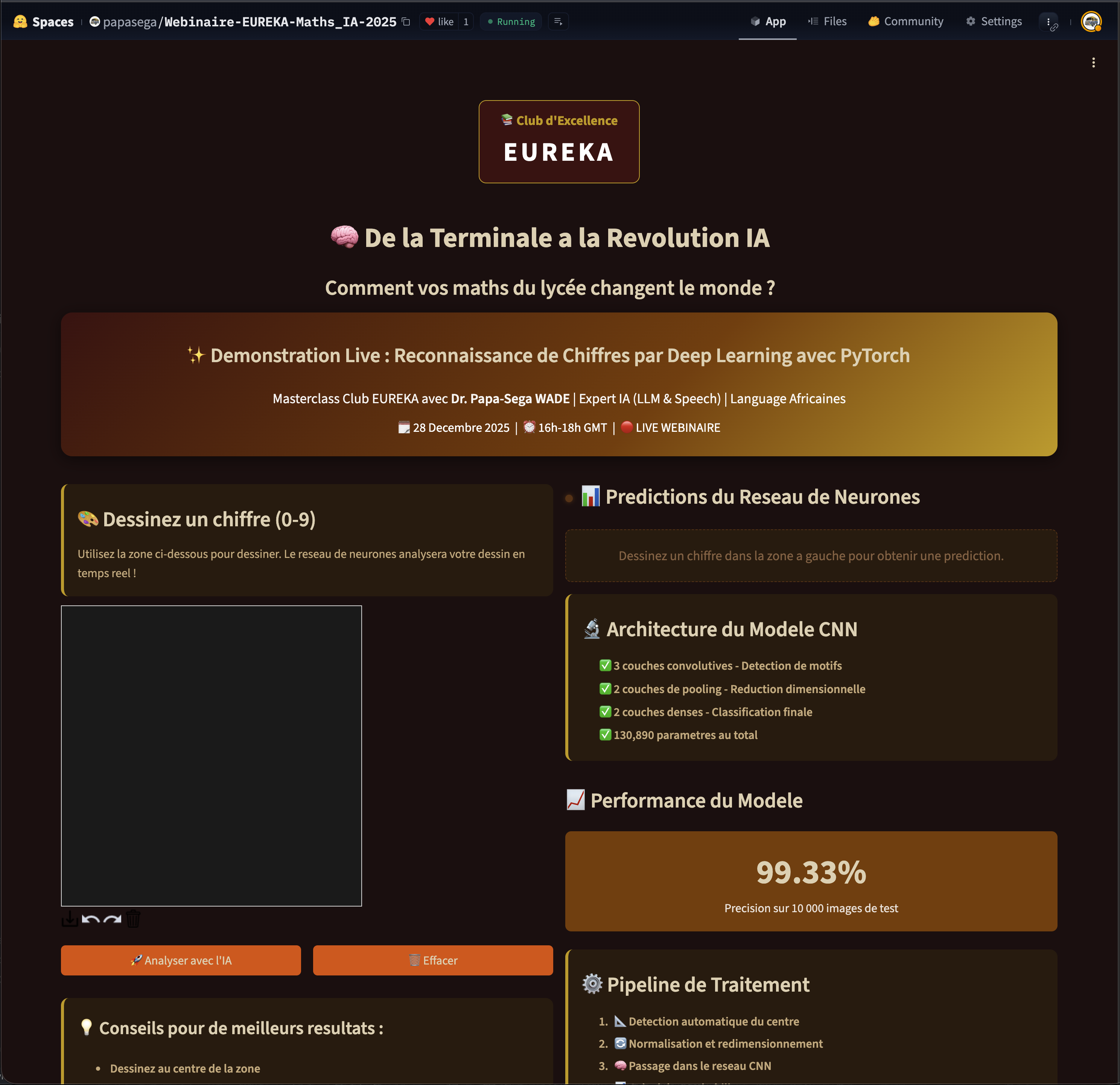
Contexte : du webinaire à la démo live
Ce webinaire s'inscrit dans la belle initiative portée par Mr Younousse SEYE, président de l'association EUREKA, visant à faire découvrir aux jeunes lycéens comment les mathématiques qu'ils étudient (sigmoïde, dérivée, matrices) constituent les véritables fondations de l'Intelligence Artificielle.
Pour rendre cet apprentissage concret lors de notre session du 28 décembre 2025, nous avons construit et déployé une démo interactive de reconnaissance de chiffres utilisant un réseau de neurones convolutif (CNN) entraîné avec PyTorch sur le dataset MNIST.
Le Space est accessible ici : 🤗 papasega/Webinaire-EUREKA-Maths_IA-2025
Le pipeline en 4 étapes
Structure du projet
├── Dockerfile
├── requirements.txt
├── mnist_cnn_v1.pth ← modèle pré-entraîné
├── train_model.py ← script d'entraînement
└── src/
└── app_with_model.py ← app Streamlit
Étape 1 : Entraîner le CNN avec PyTorch
Le script train_model.py définit un réseau compact à 3 couches convolutives et ~130k paramètres. En 5 epochs seulement, il atteint 99.33% de précision sur les 10 000 images de test MNIST.
"""
MNIST CNN Training Script
Author: Dr. Papa-Sega WADE

Usage:
    python train_model.py              # train with defaults
    python train_model.py --epochs 5   # fast training (99%+ from epoch 4)
    python train_model.py --output models/mnist_v2.pth
"""

import os
from pathlib import Path

import click
import torch
import torch.nn as nn
import torch.nn.functional as F
from loguru import logger
from torchvision import datasets, transforms


# ======================================
# MODEL DEFINITION
# ======================================
class MNISTNet(nn.Module):
    """Compact CNN for MNIST digit recognition.

    Architecture:
        Conv2D(32) -> MaxPool -> Conv2D(64) -> MaxPool -> Conv2D(64) -> FC(128) -> Dropout -> FC(10)

    Input:  (B, 1, 28, 28) float32, normalized with MNIST mu/sigma (0.1307, 0.3081)
    Output: (B, 10) raw logits
    Params: ~130k
    """

    def __init__(self) -> None:
        super().__init__()
        self.conv1 = nn.Conv2d(1, 32, 3)   # 28x28 -> 26x26
        self.conv2 = nn.Conv2d(32, 64, 3)  # 13x13 -> 11x11
        self.conv3 = nn.Conv2d(64, 64, 3)  # 5x5   -> 3x3
        self.pool = nn.MaxPool2d(2, 2)
        self.fc1 = nn.Linear(64 * 3 * 3, 128)
        self.dropout = nn.Dropout(0.5)
        self.fc2 = nn.Linear(128, 10)

    def forward(self, x: torch.Tensor) -> torch.Tensor:
        x = self.pool(F.relu(self.conv1(x)))  # -> (B, 32, 13, 13)
        x = self.pool(F.relu(self.conv2(x)))  # -> (B, 64,  5,  5)
        x = F.relu(self.conv3(x))             # -> (B, 64,  3,  3)
        x = x.view(-1, 64 * 3 * 3)
        x = F.relu(self.fc1(x))
        x = self.dropout(x)
        return self.fc2(x)

    def count_parameters(self) -> int:
        return sum(p.numel() for p in self.parameters())


# ======================================
# TRAINING
# ======================================
def train(model, train_loader, optimizer, criterion, device, epoch, total_epochs):
    """Run one training epoch."""
    model.train()
    total_loss = 0.0
    for batch_idx, (data, target) in enumerate(train_loader):
        data, target = data.to(device), target.to(device)
        optimizer.zero_grad()
        loss = criterion(model(data), target)
        loss.backward()
        optimizer.step()
        total_loss += loss.item()
        if batch_idx % 100 == 0:
            pct = 100.0 * batch_idx / len(train_loader)
            logger.info(
                "Epoch {epoch}/{total} [{pct:.0f}%]  loss={loss:.4f}",
                epoch=epoch, total=total_epochs, pct=pct, loss=loss.item(),
            )
    return total_loss / len(train_loader)


def evaluate(model, test_loader, device):
    """Evaluate model on test set. Returns accuracy in [0, 1]."""
    model.eval()
    correct = total = 0
    with torch.no_grad():
        for data, target in test_loader:
            data, target = data.to(device), target.to(device)
            pred = model(data).argmax(dim=1)
            correct += pred.eq(target).sum().item()
            total += target.size(0)
    return correct / total


# ======================================
# CLI ENTRYPOINT
# ======================================
@click.command()
@click.option("--epochs",     default=5,                  show_default=True)
@click.option("--batch-size", default=128,                show_default=True)
@click.option("--lr",         default=1e-3,               show_default=True)
@click.option("--data-dir",   default="./data",           show_default=True)
@click.option("--output",     default="mnist_cnn_v1.pth", show_default=True)
def main(epochs, batch_size, lr, data_dir, output):
    """Train a compact CNN on MNIST and save weights to a .pth file."""
    device = torch.device("cuda" if torch.cuda.is_available() else "cpu")
    logger.info("Device: {device}", device=device)

    transform = transforms.Compose([
        transforms.ToTensor(),
        transforms.Normalize((0.1307,), (0.3081,)),
    ])
    train_dataset = datasets.MNIST(data_dir, train=True,  download=True, transform=transform)
    test_dataset  = datasets.MNIST(data_dir, train=False, download=True, transform=transform)
    train_loader = torch.utils.data.DataLoader(train_dataset, batch_size=batch_size, shuffle=True)
    test_loader  = torch.utils.data.DataLoader(test_dataset,  batch_size=1000, shuffle=False)

    model = MNISTNet().to(device)
    logger.info("Parameters: {n:,}", n=model.count_parameters())
    optimizer = torch.optim.Adam(model.parameters(), lr=lr)
    criterion = nn.CrossEntropyLoss()

    best_acc = 0.0
    output_path = Path(output)
    output_path.parent.mkdir(parents=True, exist_ok=True)

    for epoch in range(1, epochs + 1):
        avg_loss = train(model, train_loader, optimizer, criterion, device, epoch, epochs)
        acc = evaluate(model, test_loader, device)
        logger.info("Epoch {e}/{t}  loss={l:.4f}  acc={a:.4f}", e=epoch, t=epochs, l=avg_loss, a=acc)
        if acc > best_acc:
            best_acc = acc
            torch.save(model.state_dict(), output_path)
            logger.success("Saved best model -> {p}  (acc={a:.2f}%)", p=output_path, a=best_acc*100)

    logger.success("Training complete. Best: {a:.2f}%  -> {p}", a=best_acc*100, p=output_path)

if __name__ == "__main__":
    main()
python train_model.py --epochs 5 --output mnist_cnn_v1.pthmnist_cnn_v1.pth est sauvegardé avec les meilleurs poids.
Étape 2 : L'application Streamlit
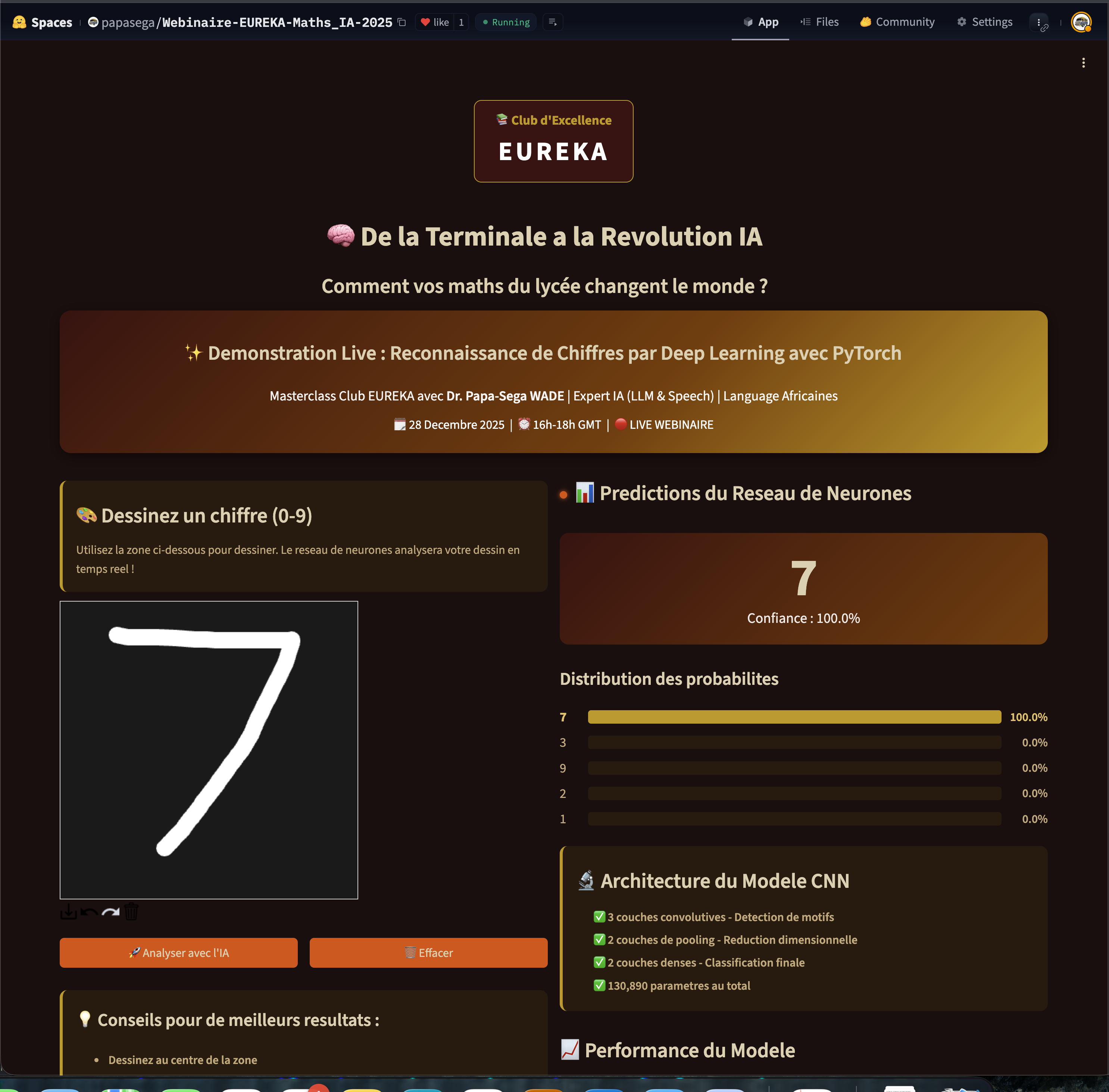
L'application charge le modèle pré-entraîné sans aucun entraînement à l'exécution. L'utilisateur dessine un chiffre sur un canvas interactif, et le CNN prédit en temps réel avec la distribution de probabilités.
Points clés du code
- Injection de thème dark au runtime : le fichier
.streamlit/config.tomlest créé automatiquement au démarrage - Prétraitement MNIST-fidèle : recadrage, redimensionnement proportionnel à 20px, padding 28×28, recentrage par centre de masse, normalisation μ/σ
- Canvas interactif via
streamlit-drawable-canvas, trait blanc sur fond noir - Prédiction en temps réel avec softmax et barres de probabilités
"""
EUREKA MNIST Demo - Streamlit App (bundled model, no training at runtime)
Author: Dr. Papa-Sega WADE

Run locally:
    python train_model.py --epochs 5 --output mnist_cnn_v1.pth
    streamlit run src/app_with_model.py

On HuggingFace Space:
    Push mnist_cnn_v1.pth alongside src/ — app loads it instantly, zero training wait.
"""

import math, os
from pathlib import Path

# ── Inject dark theme at runtime ──
_CONFIG_DIR = Path(__file__).parent / ".streamlit"
_CONFIG_FILE = _CONFIG_DIR / "config.toml"
if not _CONFIG_FILE.exists():
    _CONFIG_DIR.mkdir(parents=True, exist_ok=True)
    _CONFIG_FILE.write_text(
        '[theme]\nbase = "dark"\nbackgroundColor = "#1C0F0F"\n'
        'secondaryBackgroundColor = "#2A1A0E"\nprimaryColor = "#E04E00"\n'
        'textColor = "#E0D0B0"\nfont = "sans serif"\n'
    )

import cv2, numpy as np, streamlit as st
import torch, torch.nn as nn, torch.nn.functional as F
from scipy.ndimage import center_of_mass
from streamlit_drawable_canvas import st_canvas
from torchvision import datasets, transforms

st.set_page_config(
    page_title="MNIST EUREKA - De la Terminale a la Revolution IA",
    page_icon="🧠", layout="wide",
)

# ── CNN Model (same architecture as train_model.py) ──
class MNISTNet(nn.Module):
    def __init__(self):
        super().__init__()
        self.conv1 = nn.Conv2d(1, 32, 3)
        self.conv2 = nn.Conv2d(32, 64, 3)
        self.conv3 = nn.Conv2d(64, 64, 3)
        self.pool = nn.MaxPool2d(2, 2)
        self.fc1 = nn.Linear(64 * 3 * 3, 128)
        self.dropout = nn.Dropout(0.5)
        self.fc2 = nn.Linear(128, 10)

    def forward(self, x):
        x = self.pool(F.relu(self.conv1(x)))
        x = self.pool(F.relu(self.conv2(x)))
        x = F.relu(self.conv3(x))
        x = x.view(-1, 64 * 3 * 3)
        x = F.relu(self.fc1(x))
        x = self.dropout(x)
        return self.fc2(x)

    def count_parameters(self):
        return sum(p.numel() for p in self.parameters())

# ── Load pre-trained weights ──
MODEL_PATH = Path("mnist_cnn_v1.pth")

@st.cache_resource
def load_model():
    if not MODEL_PATH.exists():
        st.error("Model file not found. Run: python train_model.py --epochs 5")
        st.stop()
    model = MNISTNet()
    model.load_state_dict(torch.load(MODEL_PATH, map_location="cpu", weights_only=True))
    model.eval()
    return model

model = load_model()

# ── Preprocessing (MNIST-faithful pipeline) ──
def preprocess_canvas(img_array):
    """Convert raw canvas RGBA to normalized 28x28 MNIST tensor."""
    if img_array is None:
        return None
    gray = cv2.cvtColor(img_array[:,:,:3].astype(np.uint8), cv2.COLOR_RGB2GRAY)
    ink_mask = (gray > 50).astype(np.uint8) * 255
    if np.sum(ink_mask) == 0:
        return None

    # Tight crop
    rows_ink = np.where(ink_mask.any(axis=1))[0]
    cols_ink = np.where(ink_mask.any(axis=0))[0]
    if len(rows_ink) == 0:
        return None
    cropped = ink_mask[rows_ink[0]:rows_ink[-1]+1, cols_ink[0]:cols_ink[-1]+1]

    # Proportional resize to max 20px
    h, w = cropped.shape
    if h >= w:
        new_h, new_w = 20, max(1, int(round(w * 20.0 / h)))
    else:
        new_w, new_h = 20, max(1, int(round(h * 20.0 / w)))
    resized = cv2.resize(cropped, (new_w, new_h), interpolation=cv2.INTER_AREA)
    _, resized = cv2.threshold(resized, 64, 255, cv2.THRESH_BINARY)

    # Pad to 28x28
    pad_t = int(math.ceil((28 - new_h) / 2.0))
    pad_b = int(math.floor((28 - new_h) / 2.0))
    pad_l = int(math.ceil((28 - new_w) / 2.0))
    pad_r = int(math.floor((28 - new_w) / 2.0))
    padded = np.pad(resized, ((pad_t, pad_b), (pad_l, pad_r)), "constant")

    # Recenter by center of mass
    cy, cx = center_of_mass(padded)
    M = np.float32([[1,0,int(round(14.0-cx))],[0,1,int(round(14.0-cy))]])
    centered = cv2.warpAffine(padded, M, (28, 28))

    # MNIST normalization
    img_f = centered.astype(np.float32) / 255.0
    img_f = (img_f - 0.1307) / 0.3081
    return img_f.reshape(1, 1, 28, 28)

# ── UI : canvas + prediction (simplified for article) ──
canvas_result = st_canvas(
    stroke_width=22, stroke_color="#FFFFFF", background_color="#1A1A1A",
    height=400, width=400, drawing_mode="freedraw", update_streamlit=True, key="canvas",
)

if canvas_result.image_data is not None:
    processed = preprocess_canvas(canvas_result.image_data)
    if processed is not None:
        tensor_in = torch.FloatTensor(processed)
        with torch.no_grad():
            probs = F.softmax(model(tensor_in), dim=1)[0].numpy()
        predicted = int(np.argmax(probs))
        confidence = float(probs[predicted]) * 100
        st.markdown(f"### Prédit : **{predicted}**  (confiance : {confidence:.1f}%)")
Étape 3 : Le Dockerfile pour Hugging Face Spaces
Hugging Face Spaces supporte les applications Docker. On fournit un Dockerfile qui installe les dépendances, copie le modèle pré-entraîné et lance Streamlit directement.
FROM python:3.11-slim

WORKDIR /app

RUN apt-get update && apt-get install -y \
    build-essential \
    curl \
    git \
    libgl1 \
    libglib2.0-0 \
    && rm -rf /var/lib/apt/lists/*

COPY requirements.txt ./
RUN pip install --no-cache-dir -r requirements.txt

# Injection explicite du modèle pré-entraîné
COPY mnist_cnn_v1.pth ./
COPY src/ ./src/

EXPOSE 8501
HEALTHCHECK CMD curl --fail http://localhost:8501/_stcore/health

ENTRYPOINT ["streamlit", "run", "src/app_with_model.py", \
    "--server.port=8501", \
    "--server.address=0.0.0.0", \
    "--server.headless=true"]
Déploiement sur Hugging Face
- Créez un nouveau Space sur huggingface.co/new-space avec le SDK Docker
- Clonez le repo du Space et copiez-y vos fichiers :
# Structure à pousser dans le Space :
# Dockerfile
# requirements.txt
# mnist_cnn_v1.pth        ← modèle pré-entraîné (~500 KB)
# src/app_with_model.py   ← application Streamlit
- Faites un
git pushet Hugging Face build automatiquement le conteneur Docker et déploie l'application. - Votre démo est live ! 🎉
mnist_cnn_v1.pth ne fait que ~500 KB car PyTorch ne sauvegarde que les poids (state_dict), pas l'architecture entière. C'est ce qui rend le déploiement rapide et léger.
Pour aller plus loin
Cet article complète le webinaire EUREKA 2025 où nous avons expliqué pas à pas les mathématiques du lycée qui font fonctionner ce réseau de neurones : la sigmoïde, la descente de gradient, la backpropagation, et l'architecture CNN.
IA & Mathématiques : De la Terminale à la Révolution IA — Webinaire EUREKA 2025
Neurones, sigmoïde, dérivée, backpropagation, CNN — tout expliqué à partir des maths du lycée.
Ressources
- 🤗 Space Hugging Face : papasega/Webinaire-EUREKA-Maths_IA-2025
- Notebook Colab : Ouvrir le Notebook sur Google Colab
- Site web : papasegawade.com
Captures d'écran de la démo
Voici l'application en action sur Hugging Face Spaces :